
At Okanagan College, research is open to both staff and faculty. If you have a project idea, we encourage you to contact the Applied Research office. We can assist you in identifying potential funding opportunities and community partners.

Researchers
Engage in Applied Research: collaborate, innovate, and impact your community!
Funding Opportunities
Internal Grants
The Office of Applied Research is partially supported by grant funding from the Natural Sciences and Engineering Research Council (NSERC) under the Mobilize program. These funding opportunities are open to all OC faculty and staff.
Purpose:
The purpose of Okanagan College’s Mobilize Capacity Development grants is to enhance the research and impact of Okanagan College by providing access to research funding that can enrich student applied research training opportunities, create or further develop research relationships with community and industry that can lead to more challenging and involved projects, support a researcher, and/or address a partner’s innovation challenge.
Scope and Eligibility:
Mobilize Capacity Development grants support OC researchers to conduct research that identifies and pursues innovation and the utilization of applied research to solve community and industry problems. Key thematic areas for Okanagan College are social innovation, sustainable building, and sustainable environments, but applied research projects are invited under the broad umbrella of innovation in alignment with Okanagan College’s strategic plan.
See program terms for specific eligibility requirements.
Awards Available:
| Type | Value | Match required | Purpose | Term | Deadline |
| Develop | Up to $10,000 | Minimum of 25% of total project budget | Seed new applied research projects and partnerships | Up to 1 year | Continuous intake, pending available funding |
| Extend | Funding for up to 2 course releases per academic or calendar year | External funding of at least $20,000 | Provide course release for externally funded applied research | Tied to teaching schedule and external funding | Continuous intake, pending available funding |
| Mentor | Up to $5000 | No match required, but must have already used GIA and AR/RA funding for fiscal year | Provide applied research opportunities for students; enhance applied research projects; seed new projects | Up to 1 year | Continuous intake, pending available funding |
Mobilize Develop: Seed funding for new applied research projects or funds to grow an existing project.
Grant Terms
Application Form
Budget Template
Mobilize Extend: Funding for course release for researchers with projects who have secured external funding.
Grant Terms
Application Form
Mobilize Mentor: Funding for researchers to hire research assistants.
Grant Terms
Application Form
Applied Research is pleased to administer the General Research Fund (GRF) internal grants program. Funded through residual balances from expired SSHRC and NSERC grants held by OC researchers, the internal grants program reinvests these funds back into the institutional research environment.
Overview of GRF internal grant program and streams including background on GRF, internal use guidelines, and scope and eligibility.
| Type | Value | Partner Contribution | Purpose | Term | Deadline |
| Seed ** | Up to $7500 | Yes, cash or in-kind, no minimum. | To support researchers in developing a new project. ** | Up to 1 year | Summer intake: July 31, 2026 Fall intake: September 30, 2026 ** Due to available funding, only applications focused on NSERC subject matter are being accepted for these intakes. At the discretion of the Director, applications may be expedited for approval. See terms for details/criteria. |
| Bridge | Up to $7500* *some exceptions | To support researchers who are between funding applications. | Up to 1 year | Continuous intake, pending funding availability | |
| Dissemination | Up to $2500 | Offset costs of disseminating the results of externally-funded projects | Up to 1 year | Continuous intake, pending funding availability |
The program includes three funding streams designed to support research at different stages:
Seed Grants jump-start new research projects for both emerging and established researchers.
Grant Terms
Application Form - Due by 11:59pm on the intake deadlines listed above. Send to OCAppliedResearch@okanagan.bc.ca
Proposal Template (ARD version)
Budget Template
Bridge Grants help sustain projects during gaps between external funding applications.
Grant Terms
Application Form - continuous intake
Dissemination Grants support the sharing of results from externally funded research.
Grant Terms
Application Form - continuous intake
Applied Research is excited to continue the Student Research Assistant (SRA) Program, designed to promote access to research support across the institution. This fund aims to assist researchers with the costs of hiring research assistants not covered by other grants or funding. This fund is available to any OC employee currently engaged in a research project.
To qualify for funding, the project should:
- Be a defined applied research project
- Provide an OC student with an opportunity to engage meaningfully in a research project
Okanagan College maintains a Grants-in-Aid (GIA) fund to support research, scholarly and creative activity among members of the Okanagan College Faculty Association (OCFA). The OCFA collective agreement (Article 18.1.4.1) defines scholarly activity as:
“Scholarly activity shall be understood to include scholarship, research and creative activities. Scholarship involves oral or written activities that reflect a thorough and critical collection of knowledge of one’s profession or discipline. Research involves contributing to the expansion of knowledge and the sharing of that knowledge through appropriate professional means. Research includes application of research findings for purposes of practical application. Creative activities involve creative practice, exhibition, performance, composition, multimedia presentations and other similar activities that reflect applied practice of one’s profession or discipline.”
Each OCFA member may receive up to $4,000 per fiscal year from the GIA fund. This amount is subject to annual review.
Updated GIA Guidelines, Application Forms, and Report Forms are available here.
Please note that GIA has a new email address. All applications, reports, and questions should be sent to: GrantInAid@okanagan.bc.ca
With any other questions or queries, please feel free to contact Shannon Hawthorne at shawthorne@okanagan.bc.ca, or at ext. 4962
The College and Community Social Innovation Fund (CCSIF) is an NSERC-sponsored funding opportunity under the College and Community Innovation program (CCI). The funding opportunity is open once per year, typically launching mid-late November with a typical due date of mid-late February. As Colleges are limited to 5 total applications that can be submitted to each competition, Okanagan College requires an internal letter of intent (LOI). Due dates will be announced here and in internal communications.
This round of CCSIF applications from OC is well underway. Future due dates will be announced here and in internal communications.
Questions about this opportunity, applications, and LOIs can be directed to Samantha Sandhu (ssandhu@okanagan.bc.ca).
External Grants
Natural Sciences and Engineering Research Council (NSERC)
The Tri-Agency College and Community Innovation program (an umbrella term for a variety of grant opportunities) is one of the largest vehicles for funding applied research at colleges (including polytechnics and CEGEPs) across Canada. It strengthens research links and collaborations between Canadian colleges and other colleges, universities and/or partner organizations from the private, public, and not-for-profit sectors that have a common goal of creating economic, social, health and/or environmental benefits for Canada. The funding that the CCI program provides to applied research and development projects makes it easier for the partner organizations to collaborate and access the wealth of resources Canada’s innovative college system has to offer. The CCI program:
- Provides partner organizations access to the unique knowledge, expertise, and capabilities available at Canadian colleges and universities.
- Trains college students in essential technical skills required by organizations in the private, public, or not-for-profit sectors.
- Provides economic, environmental, health and/or social benefits to the partner organization(s) and to Canada.
- Allows a wide range of collaborations among colleges, universities and/or partner organizations.
Applied Research and Development grants support research and development projects led by college researchers in partnership with private, public, or not-for-profit organizations while encouraging collaboration with universities and/or other colleges.
Funding: Up to $150,000 per year, over 1 to 3 years.
Application Deadline: applications can be submitted at any time.
CCSIF grants support colleges conducting multidisciplinary research and collaborating on projects with community partner organizations. They should foster community innovation by connecting the talent, facilities and capabilities of Canada’s colleges and polytechnics with the research needs of community organizations. CCSIF proposals should facilitate collaborative and innovative research that brings together researchers, students, and partners to address challenges in community innovation in the social sciences, humanities, health sciences, natural sciences and engineering research fields.
CCSIF grants enable colleges to increase their capacity to work with communities, with the goal of developing partnerships that foster community innovation in areas such as the integration of vulnerable populations, community development, education and training, climate change, environmental degradation, and health and well-being.
Although curriculum development may be included in the proposal, it must not be the project's primary objective. Proposals must include a research component and/or address research challenges in community innovation.
A maximum of five applications can be submitted per college to each competition in any research area covered by the Tri-Agency, but a different principal investigator should lead each proposal.
Funding: Up to $120,000 per year, over 1 to 3 years.
The objective of Idea to Innovation (I2I) grants is to accelerate the pre-competitive development of promising technology originating from the university and college sector, and to promote its transfer to a new or established Canadian company. I2I grants provide funding to college and university faculty members to support research and development projects with recognized technology transfer potential. This is achieved through defined phases by providing crucial assistance in the early stages of technology validation and market connection. There are four distinct funding options, characterized by the maturity of the technology or the involvement of an early-stage investment entity or industrial partner.
Eligible research and development activities include:
- Refining and implementing designs
- Verifying application
- Conducting field studies
- Preparing demonstrations
- Building prototypes
- Performing beta trials
Funding: Varies by activity.
Application Deadline: 4 submissions per year. See link below for 2026 dates.
The Synergy Awards for Innovation were launched in 1995 by NSERC to recognize partnerships in natural sciences and engineering research and development between universities and Canadian industry. In recognition of an evolving research environment, the Synergy Awards for Innovation now also reward research partnerships taking place with colleges and research partnerships beyond those with industrial partners. Since their inception, the Synergy Awards for Innovation have honoured the most outstanding achievements of these collaborations. By working together, award-winning partner organizations and post-secondary institutions have proven that effective partnerships and innovation are the foundation of achievement. Their success has enriched the academic and research programs within Canadian post-secondary institutions while providing concrete benefits to Canadians.
The Synergy Awards for Innovation are intended to showcase innovation and the benefits of uniting strengths to make the most of Canadian ingenuity.
College Partnerships
These involve a partnership between one or more eligible Canadian colleges and one or more non-academic partner organizations. The highlighted research partnership can be across the spectrum of natural and social sciences, engineering, humanities, or health.
Partnerships involving both eligible Canadian colleges and universities, and one or more partnering organizations, are eligible. The partnership should be presented under the category (University partnerships or College partnership) corresponding to the nominee’s affiliation.
Funding: Please see NSERC website for details
Nomination Deadline: See link below.
Social Sciences and Humanities Research Council (SSHRC)
SSHRC’s Research Partnerships program realizes the potential for social sciences and humanities research to influence, benefit and impact within and beyond post-secondary institutions, by supporting research and related activities and tools that facilitate the co-creating and exchanging of research knowledge while supporting the next generation of scholars.
The program objectives are to:
- Strengthen knowledge and understanding by leveraging perspectives from across multiple disciplines and sectors.
- Support collaboration among post-secondary institutions, and between post-secondary institutions and organizations from the public, private and not-for-profit sectors, to co-create knowledge and increase use of research outputs.
- Mobilize research knowledge, within academia and other sectors, that can lead to intellectual, cultural, social, and economic outputs and outcomes.
- Increase the accessibility and use of research knowledge within and beyond the post-secondary sector.
- Support a high-quality training experience for students and/or postdoctoral researchers.
Please see the SSHRC website for rules involving multiple applications: individual and institutional.
For Formal Partnerships
Partnership Engage Grants provide short-term and timely support for partnered research activities that will inform decision-making at a single partner organization from the public, private or not-for-profit sector. The small-scale, stakeholder-driven partnerships supported through Partnership Engage Grants are meant to respond to immediate needs and time constraints facing organizations in non-academic sectors. In addressing an organization-specific need, challenge and/or opportunity, these partnerships let non-academic organizations and post-secondary researchers access each other’s unique knowledge, expertise, and capabilities on topics of mutual interest.
Funding: $7,000 to $25,000 for one year.
Application deadline: 4 competitions per year. See link for exact dates.
Partnership Development Grants are expected to respond to the objectives of the Research Partnerships program. These grants provide support over one to three years to teams/partnerships, led by a project director, to:
- Develop research and/or related activities in the social sciences and humanities—these can include knowledge mobilization and the meaningful involvement of students and emerging scholars—by fostering new partnerships with existing and/or potential partners; or
- Design and test new partnership approaches for research and/or related activities that can result in best practices or models—these can either be adapted by others or have the potential to be scaled up to a regional, national, or international level.
Partnership funding is intended for formal partnerships between postsecondary institutions and/or organizations of various types.
The quality of training, mentoring and employability plans for students and emerging scholars will be evaluated as an important part of the proposed initiative.
Funding: $75,000 to $200,000 over 1 to 3 years
Application Deadline: 1 competition per year. See website for exact deadline.
Partnership Grants are expected to respond to the objectives of the Research partnerships program. These grants provide support for new and existing formal partnerships over four to seven years to advance research, research training and/or knowledge mobilization in the social sciences and humanities. This is done through mutual co-operation and sharing of intellectual leadership, as well as through resources as shown by cash and/or in-kind contributions.
Partnership Grants are intended for large teams of postsecondary institutions and/or organizations of various types that work in formal collaboration.
The quality of training, mentoring and employability plans for students and emerging scholars will be evaluated as an important part of the proposed initiative.
Funding:
Stage 1: up to $20,000
Stage 2: up to $2.5 million (by invitation only)
Application Deadline: See link below.
For Individuals and Teams
Connection grants support events and outreach activities geared toward short-term, targeted knowledge mobilization initiatives. Connection Grants support workshops, colloquiums, conferences, forums, summer institutes, or other events or outreach activities that facilitate:
- Disciplinary or interdisciplinary exchanges in the social sciences and humanities.
- Scholarly exchanges between those working in the social sciences and humanities and those working in other research fields.
- Intersectoral exchanges between academic researchers in the social sciences and humanities and researchers and practitioners from the public, private or not-for-profit sectors.
- International research collaboration and scholarly exchanges with researchers, students and non-academic partners from other countries.
Although only a Canadian institution that holds institutional eligibility can administer funds, the intellectual leadership and governance for Connection Grant activities can come from within the research community and/or from within the not-for-profit sectors.
SSHRC welcomes applications involving Indigenous research, as well as those involving research-creation. Connection Grants would support events and outreach activities related to research-creation and Indigenous research.
Individuals can apply, as an applicant, for only one Connection Grant per calendar year.
Funding:
- Events: $7,000 to $25,000
- Outreach Activities: $7,000 to $50,000 (higher amounts can be considered if well justified)
Application Deadline: 4 competitions per year. See link for exact dates.
Canadian Heritage is partnering with the Social Sciences and Humanities Research Council (SSHRC) to provide funding support through arm’s-length SSHRC Connection Grants as well as supplements to recipients of SSHRC Postdoctoral Fellowships and SSHRC Doctoral Awards (Canada Graduate Scholarships - Doctoral Scholarships and SSHRC Doctoral Fellowships).
The purpose of this funding is to:
- Promote Canadian research that will develop better understanding — based on empirical evidence — of the impacts of online disinformation in Canada to better inform programs and policies.
- Build Canada's capacity to conduct research on and related to countering online disinformation and other related online harms.
- Help foster a community of research in the digital citizenship and online disinformation space in Canada.
The Joint Initiative for Digital Citizen Research supports the goals of the Government of Canada’s approach to protecting democracy and combatting disinformation and other online harms.
Connection Grants are open to institutions, individual applicants, and teams. They provide funding to selected events and outreach activities geared toward short-term, targeted knowledge mobilization initiatives. These events and activities represent opportunities to exchange knowledge and engage on research issues related to online disinformation and other related online harms as well as their impact in the Canadian context.
Find out how to apply for the Joint Initiative for Digital Citizen Research Connection Grants.
Funding:
- Events: $7,000 to $25,000
- Outreach Activities: $7,000 to $50,000 (higher amounts can be considered if well justified)
Application Deadline: See link for exact dates.
Insight Research
The goal of SSHRC’s Insight Research program is to build knowledge and understanding about people, societies, and the world by supporting research excellence in all subject areas eligible for SSHRC funding. The objectives of the Insight Research program are to:
- Build knowledge and understanding from disciplinary, interdisciplinary and/or cross-sector perspectives through support for the best researchers.
- Support new approaches to research on complex and important topics, including those that transcend the capacity of any one scholar, institution, or discipline.
- Provide a high-quality research training experience for students.
- Fund research expertise that relates to societal challenges and opportunities.
- Mobilize research knowledge, to and from academic and non-academic audiences, with the potential to lead to intellectual, cultural, social, and economic influence, benefit, and impact.
Please see the SSHRC website for rules involving multiple applications.
Insight Grants are expected to respond to the objectives of the Insight Research program. Insight Grants support research excellence in the social sciences and humanities. Funding is available to both emerging scholars and established scholars for research initiatives of two to five years.
Stable support for long-term research initiatives is central to advancing knowledge. It enables scholars to address complex issues about individuals and societies, and to further our collective understanding.
Insight Grants support research proposed by scholars and judged worthy of funding by their peers and/or other experts. Insight Grant research initiatives can be undertaken by an individual researcher or a team of researchers working in collaboration.
Applicants choose from one of two streams, depending on the amount of funding required. Both streams will be adjudicated by the same committees, and will receive the same rigorous level of merit review. The deadlines and application process are identical for both; however, the targeted success rate for Stream A is higher than for Stream B.
Funding:
Stream A: $7,000 to $100,000
Stream B: $100,001 to $400,000
Over 2 to 5 years
Application Deadline: See link for exact date.
Insight Development Grants are expected to respond to the objectives of the Insight research program. They support research in its initial stages. The grants enable the development of new research questions, as well as experimentation with new methods, theoretical approaches and/or ideas. Funding is provided for short-term research development projects of up to two years that are proposed by individuals or teams. Insight Development Grants are not intended to support large-scale initiatives. Long-term support for research is offered through SSHRC’s Insight Grants. Proposed projects can involve, but are not limited to, the following types of research activities:
- Case studies
- Pilot initiatives
- Critical analyses of existing research
Projects can also involve national and international research collaboration, and the exploration of new ways of producing, structuring, and mobilizing knowledge within and across disciplines and sectors. Funding is available for two distinct categories of scholars:
- Emerging scholars who will develop new research questions and/or approaches. Such projects can build on and further the applicant’s (or team’s) graduate work and/or represent a continuation of their overall research trajectory.
- Established scholars who will explore new research questions and/or approaches that are distinct from the applicant’s previous/ongoing research. Research projects should be clearly defined and in the early stages of the research process. Insight Development Grant funding is not intended to support ongoing research for established scholars.
Funding: $7,000 to $25,000 over 1 to 2 years
Application Deadline: See link for exact date.
Applied Research Resources
Internal Resources and Policies
Early Release of Funds
Early release of funds allows researchers to access funds for pre-research activities before obtaining approval from the Research Ethics Board.
Requests for early release of funds are administered by the Office of Applied Research.
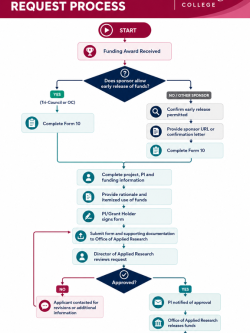
Please note that early release of funds will not be granted for activities that entail collecting research data.
Researchers may request early release of funds in the following situations:
- When there are research project start-up costs that need to be expended before the research ethics application can be submitted or before research ethics approval can be finalized
- When conditional ethics approval has been granted, i.e., the researcher is waiting for administrative or other types of approvals needed before research can begin
- Conditional approval does not authorize the researchers to begin research activity for which ethics approval is required (recruitment, consent, data collection, etc.)
- Conditional approval does not authorize the full release of funding held in the OC grant account
- In cases where operational approval is significantly delayed due to circumstances outside of the researcher’s control, authorization for full release of funding may be considered. For consideration, an email must be sent to the Director of Applied Research, mbutterfield@okanagan.bc.ca.
- When you will not be applying for ethics approval for research involving human subjects until Year 2 or later of the grant. In these instances, please contact kvrabic@okanagan.bc.ca before submitting your form.


Connect with us
Questions about Applied Research at Okanagan College?
Research Ethics Board
The Research Ethics Board (REB) reviews and monitors research involving human participants.