
It is a great time to be involved in the unfolding history of science."
Q: What is your name and role at Okanagan College?
A: I’m Ryan Ransom. I teach in the Physics and Astronomy Department at Okanagan College. My home campus is Penticton.
Q: What is your education and background?
A: I have a BSc in Space Engineering Sciences, and an MSc and PhD in Astrophysics. All degrees are from York University in Toronto.
Q: What is your area of interest?
A: I worked between 1995 and 2006 on the NASA-Stanford Gravity Probe B mission, a $1 billion spacecraft-based test of Einstein’s General Theory of Relativity. The mission successfully verified two predictions of general relativity.
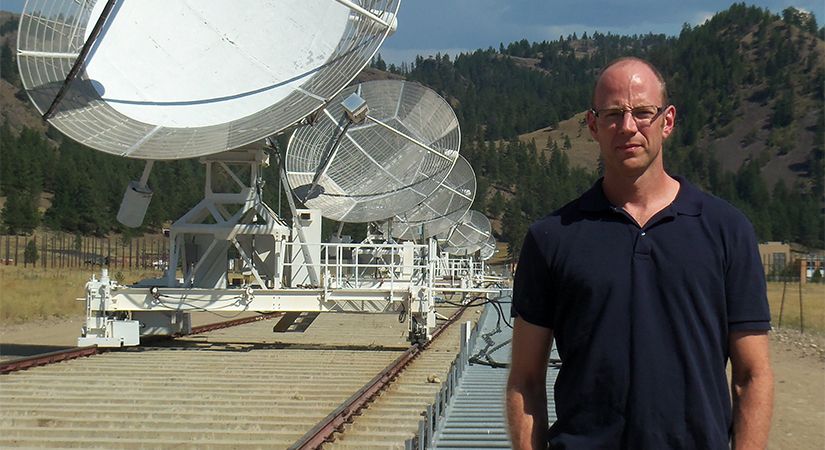
I moved with my family to Penticton in 2007 to work on the Canadian Galactic Plane Survey at the Dominion Radio Astrophysical Observatory (DRAO). My particular interest is old planetary nebulae; i.e., the expanding death clouds of Sun-type stars.
Q: When did you know you had found your discipline?
A: I have been in love with the sky for as long as I can remember. I knew from a young age that I wanted to be an astronomer.
Q: Why did you choose to work at Okanagan College?
A: It’s a great place to teach. Our small classes give instructors and students a real chance to connect. Also, the Penticton campus is just ~25 km from DRAO.
Q: What do you like most about the work you do?
A: I’m passionate about the material and really passionate about teaching/connecting. The classroom is the ultimate workplace.
Q: Tell me about your involvement with the Dominion Radio Astrophysical Observatory?
A: I was a postdoctoral fellow at DRAO in 2007-08, working on the Canadian Galactic Plane Survey. I maintain a Visiting Scientist position, which gives me ongoing access to the facility and its world-class instruments. I arrange and conduct tours of DRAO for our OC students/staff, school groups of various ages and the general public.
Q: Favourite teaching experience?
A: The “wow” moment that a student experiences when introduced to something surprising/exciting. Also, when a student who didn’t think they could “do Physics” tells me, at the end of the year, that Physics (or Astronomy) was their favourite subject 😊
Q: What advice do you have for new students?
A: Get engaged. Come to class, ask questions, get to know your instructors and your peers. Institutions like OC have fantastic support services. Don’t be afraid to ask for help/guidance.
Q: Why do you think people should enter the Physics and Astronomy field?
A: Perhaps more than ever before, society needs enthusiastic, young scientists. The big questions in Physics and Astronomy (e.g., life beyond Earth, dark matter, dark energy, the existence of a multi-verse) need to be answered. It is a great time to be involved in the unfolding history of science.
Q: If you could go back in time, is there anything you would do differently?
A: I think I’d study Astrobiology, which brings together knowledge/research from various fields. The first exoplanet wasn’t discovered until 1995, after I started graduate school. Today, the exoplanet catalogue has thousands of members. Wouldn’t it be great to be involved in the search for life in the Universe?!
Q: Where are you the happiest?
A: Either outside, enjoying our beautiful landscapes, or in the classroom. Someday, maybe, it will be celebrating a Toronto Maple Leafs Stanley Cup victory.
Associate of Science Degree
Uncover the physical and material world through observation, calculation and experimentation. Take courses in biology, chemistry, computer science, mathematics, statistics, physics and astronomy that transfer to university. Hone skills in mathematical and scientific reasoning, computer and technological literacy, research and evaluative skills, analysis, synthesis and integration of knowledge, as well as critical thinking and problem solving.
Department of Physics and Astronomy
Explore how things work and and tailor your learning to focus on synthesizing information and problem solving with an analytical eye.