
OC expertise on the world stage: Dr. Rosalind Warner at CUGH Virtual Global Health Week
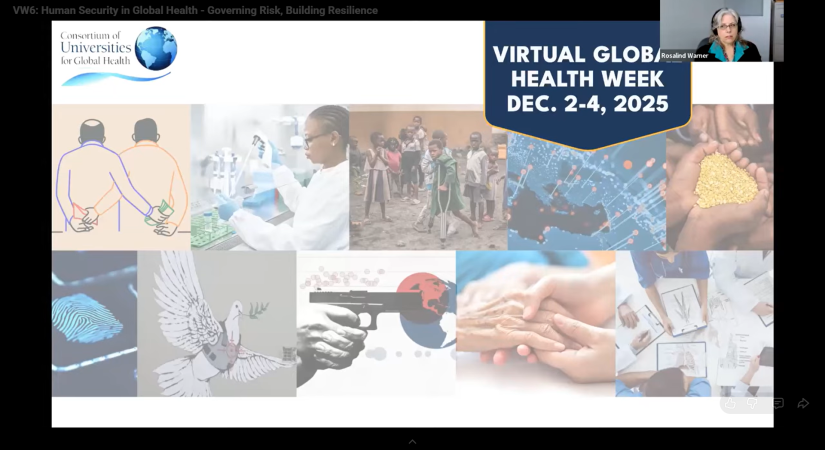
Okanagan College Political Science professor Dr. Rosalind Warner brought a local lens to a global stage last month as a featured speaker in the Consortium of Universities for Global Health’s (CUGH) 2025 Virtual Global Health Week. Her presentation, part of the session “VW6: Human Security in Global Health – Governing Risk, Building Resilience,” explored how rethinking security from the perspective of people rather than states can help build more resilient, equitable health systems worldwide.
Speaking alongside colleagues from Thompson Rivers University and the University of Alberta, Dr. Warner traced the evolution of human security from its post–Cold War roots to its relevance in today’s era of climate stress, pandemics and geopolitical upheaval.
“Human security brought a new way of thinking that would enable an expanded understanding of what security meant, going beyond military threats to include health, environmental, economic and social risks, and even political threats from the state itself,” said Dr. Warner.
Dr. Warner emphasized the shift from state‑centric to people‑centric security, arguing that protecting the well‑being and basic rights of individuals must sit alongside traditional notions of sovereignty. This approach, she noted, aligns closely with international health regulations, the Global Health Security Agenda, and the UN Sustainable Development Goals, all of which recognize that systemic risks—such as pandemics and climate change—are interconnected and unequally distributed.
During the session, the panel examined how geopolitical realignments, including China’s growing influence within global health institutions, are reshaping governance norms and raising new ethical and political questions. Dr. Warner pointed to recent pandemics and climate‑driven disasters as evidence that global health systems must move from reactive crisis response to anticipatory, adaptive governance that can manage complex, cross‑border risks.
Using examples from international legal and policy frameworks—such as the Responsibility to Protect, the Ottawa landmine treaty, and evolving global health security mechanisms—she showed how human security thinking has already informed innovations in international law and multilateral cooperation. However, she also stressed ongoing tensions between narrow national security priorities and broader human security goals, particularly when states prioritize short‑term interests over long‑term resilience and equity. For Okanagan College, Dr. Warner’s invitation to speak at CUGH underscores the College’s growing role in conversations that connect local classrooms with global challenges. As a Continuing College Professor in the Department of Political Science, her teaching and research bridge global health governance, human security and equitable development—areas that are increasingly central to how students understand today’s global “polycrisis.”
Dr. Warner’s contribution to CUGH 2025 affirms that perspectives developed at Okanagan College are informing debates on how to design health systems that can anticipate and adapt to future crises while addressing the structural drivers of vulnerability. Faculty, staff and students interested in global health, climate, and security are encouraged to watch the recording and consider how a human security lens might inform their own scholarship, teaching, and community work.